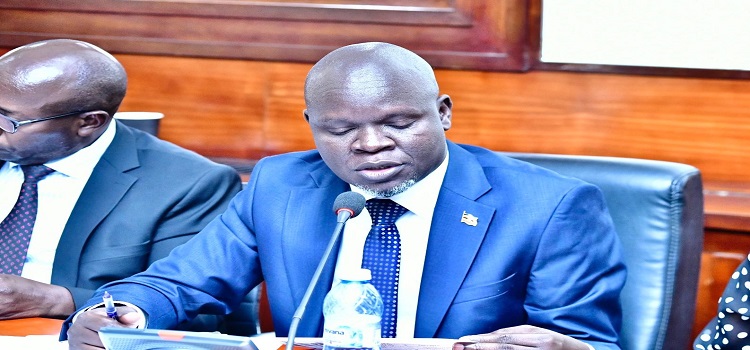
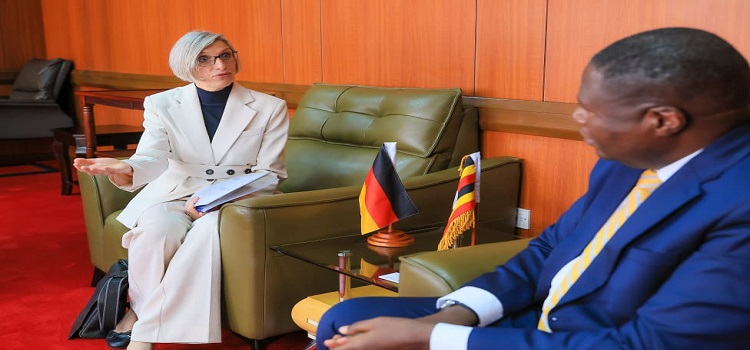
Parliament is set to reestablish the Institute of Parliamentary Studies, with support from the German Legislature, to “broaden the minds” of members and staff, Speaker, Jacob Marksons Oboth has said.
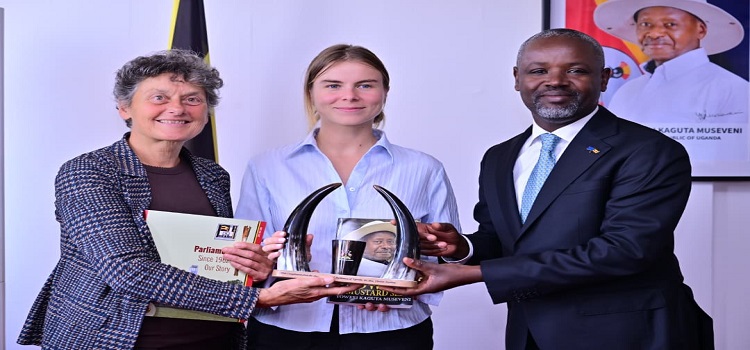
Speaker Oboth made the revelation while meeting the new German Ambassador to Uganda, H.E Sigrid Sommer, who paid a courtesy call on him at Parliament Building, on Tuesday, 22 September 2026.
“We are restarting our Institute for Parliamentary Studies to train, expose and broaden the minds of our members and staff,” Oboth said.
The IPS was first established in 2012 to provide specialized, in-house training to legislators, staff of Parliament and local governments. It was formally closed in 2021 with the repeal of the Institute of Parliamentary Studies Act, 2020. Then the functions of the Institute were taken up by the Corporate Planning and Strategy Department.
Oboth said the institute will henceforth become a central engine for training, research and capacity building, with cooperation and technical support from the German Parliament under a planned Memorandum of Understanding (MOU).
“Through cooperation with the German Parliament, we will learn and unlearn, adopt best practices and strengthen parliamentary diplomacy,” Oboth said.
He said that the MoU would facilitate delegations of MPs and, where appropriate, investors between the two countries. Further, Ugandan MPs and staff will participate in exchange and study visits to Germany to learn from parliamentary processes and institutions and promote comparative learning, helping Parliament modernize its work and improve legislative performance.
He further revealed that the diplomatic cooperation would also support joint engagement on trade, humanitarian assistance, human rights and governance.
“We really want to enable Parliament to complement traditional diplomacy, working alongside the head of state and government to ease bottlenecks for investors and development partners,” he said.
“Parliamentary diplomacy will complement mainstream diplomacy, not compete with it,” Oboth said, adding that “Through Parliament-to-Parliament cooperation, we can enhance trade, deepen bilateral relations and help unlock opportunities for our people.”
Ambassador Sommer welcomed the initiative, stressing that such exchanges are mutually beneficial, deepening Germany’s understanding of Uganda, Eastern Africa and the African continent.
Sommer thanked the Speaker for the initiative and revealed that German experts and facilitators will support training programs at the Institute in targeted thematic areas.
The Ambassador noted that an active parliamentary group on Eastern Africa in the German Bundestag had planned visits on humanitarian assistance and human rights and are expected to be rescheduled after earlier postponement due to the outbreak of Ebola.
She added that there were ongoing scholarship and internship programmes for African countries, including a Ugandan participant set to intern at a German institution.
Both sides agreed that reestablishing the IPS, backed by a structured MoU, will mark a new phase in Uganda–Germany parliamentary cooperation, strengthening institutions, enhancing skills and advancing shared strategic interests.